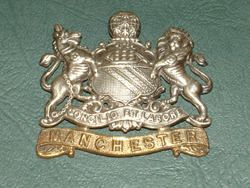
George
Cooke 51869,
23rd & 2nd Battalion Manchester Regiment
Died of Wounds on the 3rd June 1918, Aged 22 years
This photograph, believed taken in 1916, depicts my Great Uncle,
George COOKE.
Until recently, (June 2006), this ‘MANCHESTER’ had almost
been forgotten!
However, with the assistance of members of this group, his memory has
been rekindled as my researching of him continues.
George was the eldest Son of my Great Grandparents, Joseph and Jenny
COOKE and Brother to Joseph (known as Joe) and Mabel, my Grandmother.
He was born in Seaforth, Lancashire.
In 1916, the COOKE family lived at 38, Hill Street, Ashton-under-Lyne,
Lancashire. Unlike their descendants, they were Salvationists, with my
Great Grandfather being employed by the Salvation Army as an Officer.
George and Joe, unmarried young men, were not quite as dedicated! However,
both were Salvation Army ‘Soldiers’, being Bandsmen, with
George being a Trombonist!
I can not be certain of the date, but I believe in that same year, George
joined the 23rd Btn Manchester Regiment, enlisting in Ashton-under-Lyne.
It is known that Joe also served in the Army during WW1 and it was always
thought by my family that the ‘boys’ enlisted together. I
do not yet know if this is true, or if Joe joined his Brother in the Manchester
Regiment, albeit’s believed he did. I do not possess any details
as to Joe’s service record. However, I do know that he survived
the war and subsequently married Florence, a Salvation Army ‘Songster’!
Georges’ Medal Index Card (MIC) and Medal Rolls show that he subsequently
transferred to the 2nd Btn Manchester Regiment, possibly as a result of
being wounded.
In 1918 it is known that the 2nd Btn Manchesters were engaged in France
and in May and June of that year were fully occupied with active duties.
A description of what was happening at that time is documented in ‘The
History of the Manchester Regiment Volume 2’ and on page 173 it
states;
"By the end of May 8 men killed and 2nd Lieutenant Sprowell and
29 men wounded. The month of June was again one of considerable activity
in the front line with heavy fatigues of all kinds when the troops, by
pleasant fiction, were considered to be ‘at rest’.
Behind the line wiring was carried out and working and carrying parties
were constantly provided. The strain was great and casualties in killed,
missing, wounded and gassed increased daily"
The Regiments’ War Diary confirms this account recording that
the Manchesters were in the line, engaged with laying wire duties, patrolling
and establishing listening posts.
It was at this time that George was fatally wounded. To date, I’ve
not established how those wounds were caused and maybe I never will …
but perhaps one day I might?
The then Battalion HQ was located at Blairville and it is presumed that
George would have been taken to a Casualty Clearing Station somewhere
in that vicinity.
On the 3rd June 1918 George ‘Died of Wounds’. He would have
been temporarily buried nearby to the Casualty Clearing Station. He was
subsequently moved and remains to this day ‘At Rest’ in the
Cabaret Rouge British Cemetery, Souchez, Pas-de-Calais, France. (Grave/Memorial
Reference: VIII. N. 3.)
In conclusion, an Obituary appearing in The Salvation Army periodical,
‘The War Cry’, dated August 10 1918, reports the following;
"Well, mate, if my turn has come I’m quite ready"
…said Bandsman George COOKE, of Ashton-under-Lyne, to his companion
as he was going into action. These were his last words. At the Memorial
Service two souls knelt at the mercy-seat."
|
 |