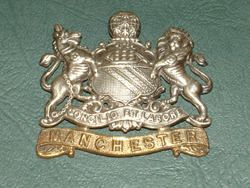
A History of the 66th (2nd East Lancashire) Division During the Great War
February 1918 – The Move To PERONNE
The titanic battles of 1916 and 1917 had exhausted the BEF and they were dangerously short of manpower. Therefore the decision had been made to move onto the defensive for 1918 and wait while the Americans built up their forces in order that the Allies could move to the attack again in 1919. In order for this to work vast new defences had to be built. This would require thousands of tons of concrete, millions of feet of planking, millions of cubic tons of excavated earth, and some poor buggers to build it. The poor buggers in this case were the 66th.
And that was pretty much the routine the men fell into throughout December and January: the daily grind of patrols, fatigue parties, and reliefs. Casualties through random German shelling and sniping were light but persistent and morale was low, with only the occasional precious few days out of the line.
Eventually all good (and bad) things come to an end, and in mid-February the news that everyone had been waiting for finally came through – they were leaving the Salient and travelling south to the old Somme battlefields just east of Peronne under the command of XIX Corps.
Although this sector of the line was far less uncomfortable and hazardous than Ypres it required just as much work – possibly even more.
In early 1917 the Germans had retreated over this part of the line and destroyed everything in their path. Every village, house, well, road, and railway was destroyed utterly. The BEF had been reconstructing the area but priority was given to other areas and it was still a mess. The new defence system was under construction here as it was everywhere else, but the 66th faced particular difficulties in addition to the havoc the Germans had wrought. The division was chronically under-strength, and most of the ‘defences’ were at best 2 feet deep ‘trace’ trenches or just lines on paper. In addition more and more units were being shifted north leaving the 66th to take over more and more of the line diminishing its fighting and working capacity still further. When the 66th did take over they found a pleasant golf course and officers mess but little evidence of ‘defences’. The 66th did what they could to create a proper defensive system, but the going was slow. When the Germans did unleash their infamous Spring Offensive most of the work was incomplete.
21st March 1918 – The Storm Unleashed
The 2/7th Manchester’s War Diary for 20 March contains one line: ‘Quiet day today’. At 4:10 a.m. on 21 March the diary records ‘Violent enemy bombardment’.
The 66th along with the 24th Division faced 6 German Divisions who were infiltrating through very heavy mist. Forward communications were instantly severed and the situation so obscure and chaotic that to this day it is difficult to reconstruct the events of 21 March 1918. Up until about 11 a.m. the Germans delivered a terrifically heavy barrage mixed with heavy concentrations of Mustard Gas. At 11.25 199 Brigade HQ received a report that forward outposts held by 2/5 and 2/6 Manchesters had been surprised in the flank due to a retirement by the 16th Division on their left. They therefore pulled back to the vicinity of COTE WOOD and CARPEZA COPSE.
Meanwhile the 2/8 LF’s had been completely surrounded and the HQ captured. The 2/7 Manchesters were putting up a stout defence of BROSSE WOOD preventing the Germans from exploiting the situation but were under heavy attack.
1 Company of 2/6 Manchesters had formed a defensive position at FERVAQUE FARM. They beat off several very heavy attacks but the Germans brought up flamethrowers and at 1.30 p.m. the farm fell. Only 8 men survived.
Further north 1 Coy of 2/9 and 2 Coys of 2/5 Manchesters held up the attack at a sunken road. At TEMPLEUX QUARRIES, a key part of the defence system, the 2/7 LF’s had been subject to gas shelling and MG fire all morning whilst the Germans worked around both their flanks. Hanging on in such an exposed position it was only a matter of time before the quarries fell. Despite an order to retire many held on until either captured or killed.
By 2 p.m. it was clear that the 66th Forward Zone had been overrun and a salient formed with both flanks dangerously exposed, but this division was far from beaten. By 6 p.m. the Coy of 2/7 Manchesters who had beaten off fierce attacks at BROSSE WOOD was finally overrun. There were pitifully few survivors. By 7 p.m. Maj. Fisher of 2/5 Manchesters and Maj. Howarth of 2/9 Manchesters were reinforcing CARPEZA COPSE with orders to hang on for as long as possible. Meanwhile the 2/6 Manchesters who had lost some ground at TEMPLEUX QUARRIES fought their way back in with dogged determination despite severe casualties and very heavy MG fire and checked the German advance. However they were now surrounded.
Meanwhile Brig.-Gen. Guy Williams (who had been promoted from Divisional CRE to command 199 Brigade) was organising a second line of defence further back with any soldiers he could lay his hands on.
By this time the Germans had out-distanced their artillery support and were checked by the desperate defence of the 66th Division. Consequently the line stabilised that evening as desperately needed supplies of food and ammunition were hastily organised.
By 10 a.m. on 22 March the German artillery was in full swing again. Miraculously some of the troops in CARPEZA COPSE had managed to fight their way out back to the British lines. However a serious situation was developing. The 16th Division to the left of 197 Brigade had retired again thus exposing 197 Brigade’s flank even further. The Brigade had no choice to retire but small parties fighting desperate rearguard actions temporarily checked the German advance yet again. Meanwhile Brig.-Gen. Williams ordered the divisional reserve (the 8th and 19th Hussars) along with 3 tanks to counter-attack. The attack was partially successful and bought much needed time for the division.
By mid-afternoon the position was untenable and the 66th was ordered to retire through the line of defence previously organised by Williams. The 50th Division who had been hurriedly brought up during the night manned this line. However the 50th Division was thinly spread and simply did not have the time to organise a coherent defence. The pursuing Germans soon broke through despite a desperate resistance. The decision was made during the night to retire all troops to the Somme River at PERONNE, which offered good defences. At 3 a.m. on the morning of the 23 March the 66th, now just a quarter of its original strength arrived at their positions. The 66th were ordered to defend the bridges at PERONNE. At 11 a.m. 2nd Lt Walker, 2nd Lt MJP Gapp and 100 OR of 2/7 Manchesters sent up an advanced party to hold the bridges at all costs. The rest of 23 March was spent preparing positions whilst the Germans pushed their artillery forward. The strength of the battalions was pitiful with the 2/5 Manchesters down to only 78 men.
On the morning of 24 March what was left of the Division moved up to the Somme River to join the advanced parties.
24-25 March – The Defence of The SOMME
All the bridges should have been destroyed but 432 Coy. RE had run out of explosives thanks to a stray RFC bomb and one bridge was still left standing. Lt. LE COMBER of 2/7 Manchester’s had managed to set the bridge on fire but the bridge still stood. By 1.45 p.m. the fight had developed again. The 66th poured incessant Lewis gun fire into the Germans but elements had managed to get across and gain footholds. By 3 p.m. the Division was so weak that the three brigades were formed into one composite Brigade, even the Divisional CO – Neil Malcolm – had been wounded. So much for ‘Chateau Generals’!
By 6.30 p.m. the situation had become very serious, though the problem was not the Germans. Inaccurate British artillery fire was massacring the division but it would be another 3 hours before the message got through to the artillery to cease fire. Despite this the 66th counter-attacked again and again into the night forcing the Germans to halt their attack that day.
The situation on the 25 March was bad and very confusing. The morning and afternoon were spent in a desperate defence of the Somme bridgeheads under intense artillery fire. The Germans began to cross the Somme in greater numbers despite sustaining massive casualties. At 6 p.m. the Division was ordered to abandon the Somme and retreat a further 5 miles to the rear. By 10 p.m. the withdrawal was complete and rations and ammunition were issued. But the ordeal wasn’t over yet.
At this point until 30 March the battle dissolved into desperate rearguard actions, hasty counter-attacks and a general retreat as the Division was slowly forced back from position to position. Finally at 8:10 p.m. on 30 March, after 212 hours of continual fighting the 18th Division relieved the 66th and the men were given a hot meal and a bed.
By 30 March the Germans had run out of steam. They had captured much ground though most of it was useless. They had failed to split the British and French as they had hoped and Ludendorff pronounced the attack a failure. More importantly along the front of the attack they had sustained massive casualties – 88,000 on the first day alone. Despite overwhelming odds the 66th had retired fighting. The next German attacks against the Ypres Salient and against the French would be much weaker and much more easily contained. The men of the 66th had done their job and displayed an almost superhuman endurance.
But what a cost! Figures for the division as a whole are difficult to collate but the casualties for 199 Brigade should give some idea of the level of sacrifice. On the morning of 21st March 199 Brigade strength equalled 2,300. When roll call was taken on 31 March there were only 461 replies.
|