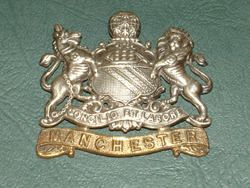
24th (Service) (Oldham Comrades) Pioneer Battalion.
The battalion was raised in Oldham in November 1914 by the Mayor & Town of Oldham. Competing with many other regiments ( including the Manchester Regiment) the town struggled to meet it's target of 1,150 men, which it finally did by January 1915. The Oldham battalion, showing it's individuality, adopted the term 'Comrades' rather than 'Pals'
They went into camp at Chadderton Hall farm off Burnley Road in Chadderton, in in 36 huts, and started their training. On the 8th March 1915 the battalion left it's home town and moved to Llanfairfechan, where training was continued.
In May 1915 they moved to Grantham as part of the 91st Brigade, 30th Division. In 10th August 1915 taken over by the War Office. In September 1915 moved to Larkhill Camp on Salisbury Plain.
In early November 1915 they landed at La Harve, and then entrained to the front, where they took their first training with the Leicesters in the Albert and Arras sectors. On the 20th December 1915 the 91st Brigade moved to 7th Division & then the 22nd Brigade, 7th Division
After a period of training the battalion were given a new career and on the 22nd May 1916 became Pioneer Battalion for the 7th Division and they moved to the village of Aumont, near Amiens, later to move to Morlancourt near Albert. Here they suffered their first casualties of the war, carrying out the duties of pioneers in the front lines and to the rear of them.
In the battle of the Somme the 24th were engaged in converting the german trenchs captaured around Fricourt into strongpoints and consoldating the gains of the 7th Division. Compared with other units the battalion suffered very light casualties of eight men. On the 14th July the battalion followed up the attack on Bazention le Petit, to build a strongpoint in the village, taking 52 casualties. On the 30th August the 7th Division was to make it's attack on the disputed village of Guinchy, the 24th were employed building the support trenches needed, although the attack was not successful, the preparation work cost the battalion 38 casualties.
In September the 24th moved away from the front to Steenwerck near Armentieres, where part of the battalion was attached to a tunneling company, others involved in building projects. In November a working party of 400 Oldhammers constructed an 800 yard new trench with three strongpoints in one night. The year continued in much the same way as the Germans retreated to the Hindenberg Line. In June 1917 the 7th division was moved up to the Ypres and then on to Hazelbrouck, then to Wizernes, to Ridge Camp near Ouderdoom. During the battle of Third Ypres the battalion was working in the Sanctury Wood area, preparing the access for the attacking troops under shell fire from the german lines and providing guides, three MMs were won by them in this time. They were moved from the forward areas on the 30th October
In November 1917 the battalion entrained for Italy, arriving at Paderno on the 19th December. Where the battalion was used in wiring and defense building along with morale biulding actions with Italian troops. they later moved to Casa di Foraro on the Asiago Plateau, where again the pioneers continued their work.
The battle of Piave in October 1918, saw the 24th employed as guides, bringing the troops up to the bridges and as pioneers preparing the ground. Assisting the RE, they kept the bridges repaired and passable bringing up supplies and in general support. By 31st October the Division had crossed the Piave and by the 3rd November, they had progressed 28 miles to the Tagliamento river.
On the 4th of November 1918, they finished the war as the Pioneer Battalion of 7th Division, Italy near Udine.
Mainly taken from and much recommended further reading
Cotton Town Comrades, Mitchinson and McInnes
available from the Museum
|