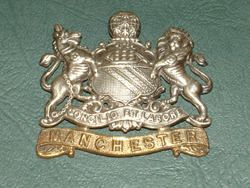
The 6th Volunteer Battalion Manchester Regiment
With it's roots in the Volunteer movement in the 1860's the Oldham volunteers came through several reorganisations to be associated with the Manchester Regiment and become the 6th Volunteer Battalion in the Cardwell reforms in the 1880s.
The first action they were involved with was in the Boer War when over a hundred of them volunteered for service overseas and went off to South Africa as part of the Volunteer Service Company. Arriving in Capetown in 1900 and leaving around a year later.
Those of the Oldham Battalion (6th Volunteer Battalion) who served:
1st Service Company
Captain P Bamford
Sergeant J H Barr Privates G H Bowden, W Dolphyn, William Emmott
T Kershaw, H Ogden, A Taylor, P Taylor, T Wadsworth, R Weston
2nd Service Company
Lieutenant G W Hardman
Sergeants C Dunkerley, H Jackson, J Mulcaster
Corporals Alfred Caley, J R Street, Lance Corporals F Dunkerley & F Williams
Drummer J Black, Privates Frank Andrew, G Armstrong, G A Ashworth, A Bancroft
James John Barber, J Bell, J Bowman, C Buckley, J Buckley , R Cash, J Chadwick,
J Coglan, S Collier, J Conway, Joseph Cubby, J Curran, C Dunkerley,
Thomas Ebdon, H Garland, A Glover, G Goodwin, S Greenhalgh, William Halkyard,
R Hall, Thomas A Hankinson, J T Heron, J Hibbert, E Holden, J Houlston, J Kiernan,
E Lane, R Lees, J Marcroft, Adam McConnochie, Philip Papworth, A Prescott,
E Rhodes, H Royle, T Schofield, W H Schofield, E Smith, W Steeple,
H V Summersgill, G Tattersall, James Pennington Trevitt, J Walne, R Waugh,
T Whitehead, H Whittaker, J S Wood, J W Wood
3rd Service Company
Colour Sergeant W Bailey, Corporal W Davies
Privates J Byron, C Collins, J E Goodwin, Edward Smith, J Wolstencroft
4th Service Company
Lance Corporal J J Cheetham,
Privates H Barber, T H Bardsley, H Belshaw, W Clegg, C G Cole
G Davies, Edward Drinkwater, John Gilham, F Harding, C Hardman, H Harrison,
W Hoddy, W Hoyle, D Hunt, J Insull, J Marsden, E Mellor, H Mellors, P W Orris,
J Rhodes, W Roebuck, John J Seddon, E F Strandring, H Stott, S E Stott, A J Taylor,
R Taylor, W Taylor, H Turner, Fred Winterburn, William Whyatt
Imperial Yeomanry
Sergeant W Chadderton, Sergeant G Marsden
Corporal A H Priestley, Privates F Newton & G Pownall
23rd (Duke of Lancaster’s) Company, Imperial Yeomanry
Private F Thompson
RAMC
Sergeant F Howarth, Privates E Barber, J Booth, T Lewis, W Lewis, R Neilson
JJ Nelson, J Nightingale, J J Shackleton
|
|
In 1908, under the Haldane reforms, the 6th VB changed again, this time to the 10th Territorial Battalion, Manchester Regiment. The territorial battalions were formed , and the men attested for home service only ( Leaving the Regulars to be able to fight abroad if needed. Weekly parades and annual camps were the norm, converting the vlounteers into a fighting force, but they were hampered by a high turnover of soldiers, for whom the lack of holiday pay and insurance made service in the Terriers unattractive.
|
1/10th (Oldham) Battalion Territorial Force
The Great War
On the 4th August 1914 the battalion was based at the HQ at the Drill Hall in Rifle Street, Oldham, Part of the East Lancashire Brigade, East Lancs Division . In mid August Kitchener annouced that the territorials would not be going to Ireland and he wanted them to volunteer for service abroad. On the 20th of August, they moved to Chesham Camp, They entrained from there to Southampton on the 10th September 1914.
The battalion sailed from Southampton for Egypt on board the Avon, passing the Indian divisions (including the 1st Battalion) going in the other direction on the 22nd september. Finally arriving Alexandria 25th September . the battalion then entrained to Cairo, and camped at the Heliopolis Racecourse. ther they were requipped with tropical gear and their training started in ernest. In January 1915 they traded camps with the 9th Battalion and moved to Abassia barracks. In mid April the battalion moved to Kantaraand on the 2nd May orders were received that they would soon to on their way to the Dardanelles.
Around 6th May 1915 they embarked from Egpt on board the Asonia and the Haverford, and on the 9th, the first men of the 10th (C& D coys)landed at Gallipoli. on W beach (Asconia) the remainder (A & B coys) caught up with them later after arriving on the 13th.
The battalion now had it's first taste of front line fighting in the trenches and began to take it's first casualties. Artillery, machine guns and snipers all took their toll, by the end of the month the battalion had over 50 casualties.
The attack on the village of Krithia was scheduled for the 4th June, the 10th was attached tothe 29th division for it ( the 10th were part of the 42nd Division normally) as the29th had suffered heavy casualties previously. The Oldhamers went over the top with dash and courage advancing to the Turkish trenches but after terrible fighting they were forced back to almost their original positions. "The blazing gorse, the groans of the wounded, the artillery and the rifle fire, the bombs and the weird cheers of our troops as they made assault after assault...made the place a vertable hell on earth" Lt Bleakley. In D Company 60 men from 188, made it to the turkish trenches, after being relieved two days later, only four made it back, somedays later the company strength was only 27 men. The casualties to the battalion are estimated at 82 killed, 320 wounded.
During July 1915, the battalion received it's first drafts from the 2/10th, who had to learn their trade under the guns of the turkish defenders.many saw their first and last action as the division was ordered to create a diversion for the landing at Suvla Bay. On the 17th August the battalion was moved out of the front line to the beach area for rest and training, which lasted four days and they wre back in again. As the months went by, disease as well as bullets and artillery took their toll and the battalon was very much changed from the one that had left England. In November heavy rain turned the trenches into small rivers, washing all before them, as winter set in, frostbite and exposure wre added to their adversaries.
Finally it was decided to evacute the tropps, Suvla and Anzac on the 10th December, while the 10th caused a diversion, a few days later the Oldhamers were withdrawn from Y beach on aboard the Robin Redbreast
After the evacuation of Gallipoli at the end December 1915 the battalion proceeded to Mudros, for a short period and then in January 1916 back to Egypt, on board the Arcadian. The battalion moved into camp near the pyramids and were re-clothed and equiped. Later they moved into the desert to Shaluf. There they received several drafts from the Manchester Regiment and other regiments. In April the 42nd Division moved to Suez, in June they moved north to El Ferdan and spent time in defense of the canal, Railway and water lines in the desert. In January 1917 the battalon moved again to El Arish, then on to Moascar, then back to Alexandria
On the 6th March 1917 the battalion arrived in Marseille and proceeded towards the western front to Huppy, where they were re-equiped ( with SMLEs, Tin helmets and Gas masks) They also got their new six figure service numbers at this time. Training and route marches were laid on.
In mid April the 10th moved off across the devasted Somme, eventually arrving at Peronne, then Buire. From here they moved to Longavesesnes, where the battalion suffered it's first casualty in the west. The 10thmoved into the line near Peiziere. In June they moved again to take over the trenches at Havincourt Wood, where they were employed patrolling and later carrying up supplies to the front line which caused the battalion more casulaties. On the 11th July they marched to Courcelles le comte, though an unpleasant place, it was out of the line and gave the men some chance a rest and training.
The 10th were then on the move again, this time to Ypres, towards the battle of Third Ypres, Passchendale. The night of the 5th September saw them move towards Railway Wood, the 42nd Division was held back for a later attack, two miles behind the front lines and were employed bringing up supplies and ammunition under heavy shellfire. They were not involved in the fighting and were later relieved and went into camp near Brandhoek. The division then moved north, relieving it's sister division , the 66th ( Second East Lancs) Division at Neiuport.
The battalions stay at Neiuport was uncomfortable but relatively light in casualties, by November they moved to a village near Dunkirk, later at the end of November they were billeted in Beuvry in the Bethune sector, where they spent the next three months in the trenches or providing working parties. There, while repelling a german attack Walter 'Spud' Mills won a posthumous Victoria Cross.
In December the battalion was relieved and went into camp in Le Quesnoy where they celebrated Christmas. In February the battalion marched back to Busnes in the Bethune area and moved up to support the portugeuse near Neuve Chapelle. The commanders were well aware of the possibility of a German attack, which came on the 21st March
On the 23rd March the 42nd Division was on the move, London Motor buses tooke them south to Adinfer Wood and they marched on to the Arras Bapaume road, the german advance had thrown the army into retreat and the division was needed to attempt to reinforce the line. As the battle waged on, the battalion found it's self in Logeast wood then to Ervillers, where they reinforced the 40th division. The Germans attacked them there in strngth but were beaten back several times, finally that evening they carried out a fighting withdrawal. After two weeks holding the line, the battalion was ordered back to Souastre where it was gratefully fed and watered.
on the 14th April the 10th moved back to the front, there they spent three weeks in and out of the front line trenches north east of Rossignol Wood, to be relieved on the 6th May. At Pas Wood the battalion took some time training up newly arrived American Troops In June they returned to the trenches south of Hebuterne. Heavy shelling and trench raids was a feature of life there and flu began to take it's toll.
The division kept up the pressure on the german lines and by August, the battalion was to attack Serre, by the 20th it was taken and the allied troops were now taking back the battlefield of the Somme. At Miraucourt, the 10th along with the 5th ELs won a important battle, and later the battalion took the village of Riencourt, winning many medals in the process.
On the 15th September, the battalion occupied Havingcourt Wood again, as it had 15 months previously. There they were gassed but the most were protected by their masks.
The 23rd saw them near Tresault, patrolling no mans land prior to an attack there on the 27th. At 2.30am the 10th followed the barrage cresting Highland Ridge and chased the germans through Couillet Wood reaching the abandoned trenches of Welsh Ridge, here the 8th Batt took over. On the 29th the Kiwis passed though and swept on towards LaVacquerie, the Hindenberg Line was broken.
On the 12 October the 10th relieved the New Zealanders on the river Selle and attacked the german lines over the river. In hand to hand fighting, men lost in the dark were led by the example of the NCOs and officers, in a ferocious battle lasting five hours, the battalion achieved it's objectives with honour. On the 6th November the battalion took Hautmont after fierce hand to hand fighting and some improved bridge building, sadly this engagement cost the lives of many men four days before the armistice
On the 11th November 1918, as part of the 126th Brigade, 42nd Division the battalion finished the war in France, Hautmont, S.W. of Maubeuge.
|